If AI is so smart, would it invest in AI?
How useful is it for investors to look to the past? Some have observed that is hard to drive forward while looking backward. Warren Buffett wryly noted that if history was the most powerful factor in investing, all the billionaires would be historians (they are not). Mark Twain might have said “History does not repeat itself, but it rhymes”. My own belief is that we can learn much from the past, and that the ability to recognize patterns and similar circumstances is a valuable tool. Which, of course, brings us to Artificial Intelligence (AI), as we still call it here on the shores of Lake Ontario.
I have been in the professional investment business for well over forty years and this does give me some perspective on what is currently happening with AI. The closest parallel in my experience was the fibre-optic boom and bust that occurred between 1998-2002, an important part of the dot-com crash that decimated the stock market in general, and the high-tech industry in particular.
In the middle to late 1990’s, the rapid increase in use of the internet by ordinary people, and the emergence of fibre-optic cable as a way of moving vast amounts of data long distances at high speed, converged. Investors and the market became convinced that the demand for fibre-optics would be essentially unlimited, and the race began to lay as much cable as possible. Companies that manufactured equipment for the industry, such as Nortel, became part of the gold rush. In the period from 1996 to 2000, investors bid up the price of these companies to previously unimaginable levels. At its peak, Nortel alone made up 36% of the entire value of the Toronto stock market and was the 9th most valuable company in the world with a market cap of $400 billion. WorldCom, a cable company, reached a market cap of almost $200 billion, and was the 14th most valuable company. Global Crossing, another cable firm, hit $50 billion on zero revenue. All three of these giant companies went bankrupt, vapourizing billions of dollars of investor wealth.
The similarity to the huge increases in the stock prices and market caps of the so-called hyper-scale companies, now valued in the trillions, is remarkable. AI has caught the imagination of investors who are apparently willing to pay almost any price to participate in the boom. In 2018, Apple became the first company in history to hit a $1 trillion market cap. Look at what has happened in the next eight years:
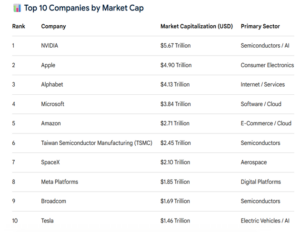
The emergence of the trillion-dollar company over the past eight years is to a significant extent a product of the AI boom. NVIDIA, Taiwan Semiconductor and Broadcom can trace their ascendence to these heights to the demand for high powered chips, used to power AI data centres. Five of the other companies (Apple, Alphabet, Microsoft, Amazon and Meta) are taking part in the AI business to one extent or another, although each of them has other significant business sectors that are themselves huge enterprises on a stand-alone basis.
For investors, the crucial question is whether NVIDIA is going to go the way of Nortel, and whether the AI sector of today will suffer the fate of the fibre-optic sector of 25 years ago. It is useful to compare some of the similarities between the two sectors to get some clues as to what might happen next. Here is a chart with six data points for each industry.
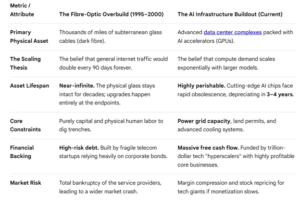
At the start of the AI boom, believers emphasized the incredible profitability of the major companies involved. They are not wrong. The hyper-scale companies generate hundreds of billions of dollars of cash flow each year. This is the most crucial difference between the two booms. The fibre-optic bubble was entirely inflated by debt, while much of the AI build-out is being financed by earned money. Much, but not all. So far about $600 billion of bonds have been issued by AI focused companies, a significant percentage of the corporate debt market. Much, much more is expected as the input components (chips, power, land, connections) become more expensive and hard to source.
A second crucial difference has to do with the nature of the assets. The fibre cable laid 25 years ago is still in use and will likely be in use 25 years from now. In contrast, the computer servers and the chips upon which they rely will likely be obsolete by the time they are installed, and to remain competitive with new data centres coming online, will need to be replaced every three years or so, at enormous cost.
Finally, at the time of the fibre optic boom, China was not a factor in world communications or technology. That is far from the case now. China is making its own chips, and they are getting better. It has its own AI models, and they too are getting better. It may be that China will be able to offer similar services to those of the big American companies at much lower prices, undercutting the market and potentially rendering the entire sector unprofitable.
For investors, this is a very difficult-to-unravel mix of opportunity and risk. We believe that AI will, in fact, be huge. Will it earn enough money to pay for the interest on the mountain of bonds, the rapid depreciation of the computer assets and the cost of power, and still leave enough profit left over to justify the lofty share prices of the companies? We don’t know, and we don’t think anyone else does either. For this reason, we have confined our investment in this sector solely to companies that were hugely profitable before AI and will remain so regardless of what happens to AI in the future. Apple will still sell phones, Amazon will still sell pretty much everything and Google will remain omnipresent.
At the end of the 1990’s and in the early 2000’s, Baskin Wealth Management was a small and young company. We took the decision at that time to avoid the dot-com companies. We did not own Nortel or other darlings of the time. When the bubble burst, our investors emerged undamaged. They might have thought we were staid and unimaginative in 1999, but they certainly appreciated our prudence by 2001. Our stance today is similar.
Media Appearances
Ernest Wong on BNN Bloomberg’s Market Call – July 7, 2026
Barry Schwartz on BNN Bloomberg’s The Close – July 13, 2026
Ernest Wong on BNN Bloomberg’s The Open – Can Big Tech justify AI spending?
Barry Schwartz on BNN – AI costs weigh on SpaceX despite Q2 beat – August 5, 2026
Barry Schwartz on BNN Bloomberg’s Market Call – August 19, 2026
Benjamin Klein on BNN Bloomberg’s Morning Markets – August 26, 2026
Barry Schwartz on BNN Bloomberg’s The Close – September 15, 2026
Ernest Wong on BNN’s Market Call – September 22, 2026
Ernest Wong on BNN Bloomberg’s The Close – September 28, 2026
Long Term Investing podcast
The Market Has Changed. Our Investing Principles Haven’t. – September 22, 2026
Meta’s New AI Could Change the Internet. What Does It Mean for Investors? – September 29. 2026
FICO Crashes, Higher Rates & the Case for Costco – October 6, 2026